Thursday, January 10, 2008

Body Heat Used to Warm Office

Sweden (TGW) – One Swedish state owned company has announced it has found an easy, green way to heat their offices: human body heat from a quarter million commuters streaming through Stockholm’s central station.

Body heat already heats the station itself, but the surplus heat will now be used to heat as much as 15% of the real estate firm Jernhusen.

"We had a look at it and thought 'We might actually be able to use this'," said Karl Sundholm, project leader at Jernhusen, which also owns the station. "This feels good. Instead of just airing the leftover heat out we try to make use of it."

Bodily warmth will be used to heat water, at a cost of $31,200. "The ventilator aggregates are already there, and even some of the pipes. All we need to do is complement with a few pumps and pipes."

Via :: Reuters

Wednesday, January 9, 2008

Could Global Warming Lead to the Next Ice Age? - Shutdown of Thermohaline Circulation

(Special Report) - If you’ve seen The Day After Tomorrow or read The Coming Global Superstorm, you probably have heard of ‘thermohaline circulation’. Okay. Maybe you haven’t heard it named, but if you’ve seen the movie or read the book then you know what it is. Unconsciously. Trust me.

Basically the central theory of both mediums is that the melting ice caps will affect the salinity (AKA the amount of salt) of the oceans and currents of the world, specifically the North Atlantic Current. The North Atlantic Current is part of the Gulf Stream, which carries heat up to East North America and West Europe. And what is the North Atlantic Current (and the Gulf Stream) powered by? Thermohaline circulation. The danger is that with a desalinated current, the current could slow or even stop, and an ice age could ensue.

Okay, that’s not likely. But global warming is going to cause thermohaline circulation to slow down. This brings us to our question:

Why will global warming cause the slowdown or shutdown of thermohaline circulation?

The answer isn’t simple. I mean, it took me a whole half an hour to even begin to comprehend. How can I expect you, the anonymous reader, to understand this in the slightest?

I’ll humor you.

To understand why global warming could cause the partial shutdown of thermohaline circulation, we first have to understand how thermohaline currents work. Thermohaline currents are NOT powered by heated convection currents, unlike most currents. But we won’t get into that. Thermohaline circulation is density driven.

You have to imagine this in 3D. The current moves north along the top of the Atlantic Ocean with less density. As it moves further north, it begins to become denser. Why does it become denser? First of all, the water cools as it gets closer to the North Pole. Cold stuff is denser than hot stuff. Second, it becomes saltier as sea ice forms. Sea ice isn’t salty, so the salt gets left behind in the water. Salt, obviously, is denser than water. So now it’s denser.

And then it sinks.

Remember, this part of the current (the north flowing current) is on the top of the Atlantic. It sinks and starts heading south. All of its dense buddies are down south, and everyone wants to be at the party, right? Strange, but true. As it moves south, it loses salinity and becomes warmer. It rises, and the cycle begins again.

Can you see the problem yet?

Global warming melts the ice caps, which are made of fresh water. Fresh water means no salt, which means less dense. The fresh water will make parts of the current less dense, slowing down the current, slowing the transportation of heat. If that makes sense.

Basically, global warming will desalinize thermohaline circulation, slowing it down.

Scientists still don’t know how much of an effect the desalinization will have. Most likely it will only lead to lesser warming in far Western Europe, but further research is still needed.

But don’t worry that there’ll be an ice age. We’ve already delayed that (well technically, if ...).

Singapore Opens Green Airport Terminal

Singapore (TGW) – Singapore opened a new, $1.22 billion green airport terminal today.


The terminal, in state owned Changi airport, boasts 919 energy-saving skylights, a butterfly garden, lower to floor air conditioners, koi ponds over 200 species of foliage spread over enough floor space to cover 50 soccer fields.

The terminal increased passenger capacity in the airport by about 50 million, and will likely lower electricity bills for the airport, mainly because of the skylights and air conditioners.

The terminal also has a five story wall of hanging plants

"The cost to run the terminal should be lower. But it's still too early to project what the cost-savings will be," said a spokesman from the Civil Aviation Authority of Singapore, which manages the airport.

Via :: Reuters

Tuesday, January 8, 2008

An Eco-Friendly 'Recyclable' Hotel

UK (TGW) – The British hotel chain Travelodge is building what they claim to be the first ‘recyclable’ hotel.

The building is made of pre-built, container like crates imported from China, stacked on each other and bolted together.

The building can be dismantled and the end of its life, picked up, and moved elsewhere.

The 120 room, 8 story building will open in June at £19 a night. “You won’t tell any difference,” a spokesman said.

"It could facilitate the creation of hotels on a temporary basis at times of peak demand in certain locations -- such as festivals or sporting events," the firm's director of property and development Paul Harvey said.

Travelodge says using the Chinese-built modules is 25 percent faster and 10 percent cheaper, making it a core part of their strategy to become the largest hotel operator in London by the 2012 Olympics.


Via :: Reuters :: The Sun

Super Soaker Inventor Aims to Double Solar Efficiency

Super Soaker Factory (TGW) - You’ve heard about advances in solar power before, but coming from the inventor of the super soaker?

Lonnie Johnson, the inventor of the super soaker, says he can achieve a conversion efficiency rate that tops 60 percent with a new solid-state heat engine.

Most photovoltaic materials have around a 30% conversion rate. In case you failed elementary school math, that’s double the current average.

Johnson, a nuclear engineer with more than 100 patents, calls his invention the Johnson Thermoelectric Energy Conversion System (JTEC).

JTEC isn’t photovoltaic; it’s more like a fuel cell.

JTEC circulates hydrogen between two membrane-electrode assemblies (MEA). Unlike a fuel cell, however, JTEC is a closed system. No external hydrogen source. No oxygen input. No wastewater output. Other than a jolt of electricity that acts like the ignition spark in an internal-combustion engine, the only input is heat.

The system works by using temperature differences in different areas to manipulate pressure in the system. One area is ultra hot and potentially heated by the sun. The cycling heat and cold produces voltage across the MEA stacks. The high voltage moves hydrogen across a stack, creating energy.

“It’s like a conventional heat engine,” explains Paul Werbos, program director at the National Science Foundation, which has provided funding for JTEC. “It still uses temperature differences to create pressure gradients. Only instead of using those pressure gradients to move an axle or wheel, he’s using them to force ions through a membrane. It’s a totally new way of generating electricity from heat.”

Using the theoretical Carnot thermodynamic cycle, a 60% efficiency rating can be predicted.

The engine can operate on tiny scales or on megawatt scales. The promise lies in the source of the heat. The heat could not only come from the sun, excess heat, or even from the human body.

Via :: Popular Mechanics

Using Basic Cost-Benefit Analysis to Understand Global Warming

“The risk of not acting far outweighs the risk of acting.”

The teacher uses basic cost-benefit analysis to show that we NEED to take action on climate change. If you have time, watch the whole thing (the WHOLE thing).

Monday, January 7, 2008

The CityCAT Air Car - Runs on Compressed Air


(Special Report) - Tata Motors, India’s largest automaker, is set to debut the world’s first commercial air powered vehicle.

The Air Car, developed by Formula One engineer Guy Negre for Moteur Developpment International (MDI), uses compressed air to power its engine.

6000 Air Cars will be on the streets of India by August 2008. The first model to be sold commercially will be the CityCAT for a measly $12700.

The car takes only a few minutes and $2 to fuel up at special compressor units, or drivers can plug the car into the electric grind and power up in 4 hours.

With a top speed of 68 miles per hour and a max range of 125 miles, one might be forgave for expecting the CityCAT to hit the streets of New York City soon. Sadly, it is unlikely, especially considering the vehicle’s all glue construction.

But if you’re German, Israeli, South African, or live in 9 other countries, you can expect to see the cars at a theater stoplight near you.


$200 Oil, Germany's Leading Economic Institute Predicts

Germany (TGW) – Oil will hit $200 a barrel, one of Germany’s leading economic institutes predicted today.


"Oil supplies are becoming increasingly scarce and that will continue to drive up prices," Claudia Kemfert, the energy expert of the DIW German Institute for Economic Research, told Berliner Zeitung newspaper.

The Institute predicted $150 oil in 5 years and $200 oil in 10 years. Kemfert added prices will likely reach $105 in the coming weeks.

Few analysts see the oil market calming anytime soon. "We find it difficult to contemplate any scenario which doesn't see annual average prices going steadily higher," said Kevin Norrish, an analyst at Barclays Capital.

Via :: Der Spiegel

Sunday, January 6, 2008

SolarReserve: Salt Powered Energy

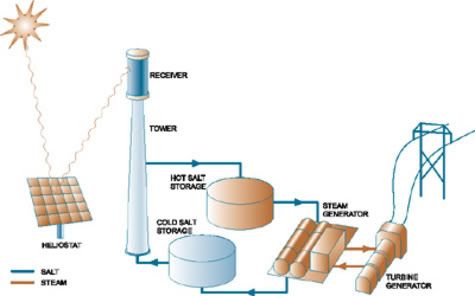
U.S. (TGW) – Solar Power tower technology and corresponding molten salt storage system developed by Rocketdyne will be commercialized through a new entity known as SolarReserve, Hamilton Sundstrand and US Renewables Group, announced today.


The technology solves the problem of solar power’s irregular power generation ability by storing energy in the form of heat in molten salt.

SolarReserve will the hold the exclusive license to Concentrated Solar Power (CSP) projects using molten salt technology.

The technology is designed for utility-scale power generation, and will be capable of producing up to 500 MW of power.

"Due to the unique ability of the product to store the energy it captures, this system will function like a conventional hydroelectric power plant, but with several advantages. We will have the capability to store the sun's energy and release it on demand. This product is more predictable than water reserves, the supply is free and inexhaustible, and the environmental impact is essentially zero," said Lee Bailey, managing director of US Renewables Group (USRG).

Via :: Press Release

[POLL] Do You Use Non-Incandescent Lightbulbs?

Voting Booth

Do you have non-incandescent lightbulbs where you live?
Yes
No
  
pollcode.com free polls

CO2 Killing Hundreds in U.S. Alone


U.S. (TGW) - Carbon dioxide (CO2) spewed by coal-fired power plants and vehicles have caused hundreds of premature deaths in the U.S. alone, a new study says.

The study does not take into account the consequences also caused by the heating of the earth.

The deaths were due to lung and heart ailments linked to ozone and polluting particles in the air, according to the report.

Mark Jacobson of Stanford University and his team used a computer model to discover that the impact is worse more populated and polluted cities.

"Of the additional ... deaths per year due to ozone and particles ... about 30 percent of those occurred in California, which has 12 percent of the (U.S.) population," he said, noting that California has six of the 10 most polluted U.S. cities.

"So it was pretty clear ... that climate change was affecting Californians' health disproportionately to its population," Jacobson said.

Via :: Reuters

Saturday, January 5, 2008

Oil Watch: December 31 to January 5 Prices, Causes and Effects


Closing price
: $97.91 per barrel (up)
National gas average: $3.01 (up)

Although we predicted oil would remain steady, oil spiked this week to over $100.

Causes:
1. Weak dollar
A lower dollar makes oil cheaper in countries that use other currencies.
1. U.S. economy
An economic report relieved some worries about the U.S. economy.
3. Mexico exports down
Because of bad weather
4. Instability in the Middle East
In Pakistan and Indonesia.

Effects:
Market jitters, rising gas prices.

Thursday, January 3, 2008

Not a lot of news lately...

Not a lot of environmental news, global warming news, alternative energy news or anything like that lately...

There's been a lot about the Iowa Caucuses. Why don't you head over to http://thethoughtsontheworld.blogspot.com for more?

Wednesday, January 2, 2008

Crystal City - World's Biggest Building Coming to Moscow, and It's Going to Be Eco-Friendly


The world’s biggest building will be coming to Moscow in 2013, and it will be energy efficient.

Covering an area of 2.5million square meters and towering above the Kremlin at 450 meters, it will be one giant hotel. There will be 3000 hotel rooms and 900 serviced apartments.


Energy Efficiency
Now the good stuff. The building is one giant spiral, creating terraces on every level. These terraces create a thermal buffer for the main building, protecting the building from Moscow’s extreme weather, saving electricity.

The building will be covered with solar panels and wind turbines. Natural ventilation will be provided thanks to numerous strategically placed large atriums.

Also, dynamic enclosure panels will be slotted into the structural framing allow daylight to penetrate deep into the heart of the scheme and can be controlled to modify the internal environment.

“Energy management is at the heart of this structure, several on-site renewable and low-carbon energy generation projects are planned,” the company said in an official press statement.


15 States to Sue EPA Over Right to Cap CO2 Emissions

U.S. (TGW) - Fifteen states said on Wednesday they filed a lawsuit against the federal Environmental Protection Agency in a bid to tighten regulations of greenhouse gas emissions from cars.