Showing posts with label Consequences. Show all posts

Wednesday, May 7, 2008

Cleaner Air Could Kill the Amazon. Wait, What?

Amazon (TGW) – Cleaner air due to fewer coal fired power plants could destroy the Amazon by the end of this century, according to researchers.

Reduced sulphur dioxide emissions by power plants causes increased sea surface temperatures in the North Atlantic, which boosts drought risk in the Amazon.

"Generally pollution is a bad thing but in this case improving the air may have ironically led to a drying of the Amazon," said Peter Cox, a researcher at the University of Exeter in Britain, who led the study.

The researchers used a climate-carbon model to simulate the impacts of future climate change on the Amazon and compared it to data from a 2005 drought that devastated a large chunk of the rainforest. They estimated that by 2025 a drought on the same scale could happen every other year and by 2060 such a crisis could hit nine out of every ten years -- enough to turn the rainforest into savannah grassland, Cox said.

The Amazon holds one tenth of the world’s carbon dioxide.

Via :: Reuters

Saturday, January 19, 2008

Study Warns of Rising Mediterranean Sea Levels

Mediterranean (TGW) – The level of the Mediterranean Sea is rising rapidly, according to a new report from the Spanish Oceanographic Institute.

The study showed levels have been rising since the 1970s and have been rising increasingly faster since the 1990s.

The study, entitled Climate Change in the Spanish Mediterranean, said the sea had risen "between 2.5mm and 10mm (0.1 and 0.4in) per year since the 1990s".

The study, entitled Climate Change in the Spanish Mediterranean, said the sea had risen "between 2.5mm and 10mm (0.1 and 0.4in) per year since the 1990s".

Via :: BBC

Wednesday, January 9, 2008

Could Global Warming Lead to the Next Ice Age? - Shutdown of Thermohaline Circulation

(Special Report) - If you’ve seen The Day After Tomorrow or read The Coming Global Superstorm, you probably have heard of ‘thermohaline circulation’. Okay. Maybe you haven’t heard it named, but if you’ve seen the movie or read the book then you know what it is. Unconsciously. Trust me.

Basically the central theory of both mediums is that the melting ice caps will affect the salinity (AKA the amount of salt) of the oceans and currents of the world, specifically the North Atlantic Current. The North Atlantic Current is part of the Gulf Stream, which carries heat up to East North America and West Europe. And what is the North Atlantic Current (and the Gulf Stream) powered by? Thermohaline circulation. The danger is that with a desalinated current, the current could slow or even stop, and an ice age could ensue.

Okay, that’s not likely. But global warming is going to cause thermohaline circulation to slow down. This brings us to our question:

Why will global warming cause the slowdown or shutdown of thermohaline circulation?

The answer isn’t simple. I mean, it took me a whole half an hour to even begin to comprehend. How can I expect you, the anonymous reader, to understand this in the slightest?

I’ll humor you.

To understand why global warming could cause the partial shutdown of thermohaline circulation, we first have to understand how thermohaline currents work. Thermohaline currents are NOT powered by heated convection currents, unlike most currents. But we won’t get into that. Thermohaline circulation is density driven.

You have to imagine this in 3D. The current moves north along the top of the Atlantic Ocean with less density. As it moves further north, it begins to become denser. Why does it become denser? First of all, the water cools as it gets closer to the North Pole. Cold stuff is denser than hot stuff. Second, it becomes saltier as sea ice forms. Sea ice isn’t salty, so the salt gets left behind in the water. Salt, obviously, is denser than water. So now it’s denser.

And then it sinks.

Remember, this part of the current (the north flowing current) is on the top of the Atlantic. It sinks and starts heading south. All of its dense buddies are down south, and everyone wants to be at the party, right? Strange, but true. As it moves south, it loses salinity and becomes warmer. It rises, and the cycle begins again.

Can you see the problem yet?

Global warming melts the ice caps, which are made of fresh water. Fresh water means no salt, which means less dense. The fresh water will make parts of the current less dense, slowing down the current, slowing the transportation of heat. If that makes sense.

Basically, global warming will desalinize thermohaline circulation, slowing it down.

Scientists still don’t know how much of an effect the desalinization will have. Most likely it will only lead to lesser warming in far Western Europe, but further research is still needed.

But don’t worry that there’ll be an ice age. We’ve already delayed that (well technically, if ...).

Monday, December 17, 2007

Sea Levels Could Rise Twice as High As Predicted

Under the sea (TGW) – The world’s sea level could rise twice as much as predicted by United Nations IPCC scientists, according to researchers.

Scientists at the Intergovernmental Panel on Climate Change (IPCC) have forecasted a maximum sea level rise of 32 inches this century, because of human induced global warming.

But researchers publishing a report in the journal Nature Geoscience said the maximum could be twice that – 64 inches.

They made the estimate by looking at previous interglacial periods when it was as hot as the Earth is expected to become this time around. They found that on average, sea levels rose 64 inches.

"Until now, there have been no data that sufficiently constrain the full rate of past sea level rises above the present level," lead author Eelco Rohling of Britain's National Oceanography Centre said in a statement.

Via :: Reuters

Friday, November 9, 2007

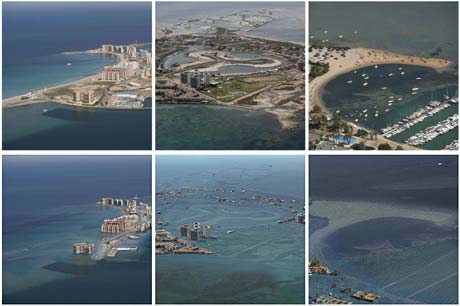
What Will Global Warming do to Spain? (Pictures)

Before is above, after below.


Credit Guardian

Wednesday, October 24, 2007

Georgia to Sue Army Corps of Engineers Over Water

Georgia (TGW) – The state of Georgia, still suffering from severe drought, confirmed this week that it will sue the Army Corps of Engineers.

Georgia Gov. Sonny Perdue said Wednesday that the state would like to see the Corps stop using Lake Lanier, at least temporarily, as the primary source of water for Atlanta.

Rainfall in the region is about 15 inches below average.

Atlanta Mayor Shirley Franklin said, "This is dire, severe, extreme drought."

Outdoor watering is banned in Atlanta and surrounding counties.

"We shouldn't have to fight this out in court," Franklin said Thursday. "We don't want to hurt [the cities and businesses] downstream but we'd like to see some middle ground and hope people would join with us."

Via :: CNN

Saturday, September 15, 2007

Northwest Passage Opens

I could remix a couple of the news reports like I usually do, but it's a lazy Saturday, right?

Direct from the source: http://www.esa.int/esaCP/SEMYTC13J6F_index_0.html

From Reuters: http://www.reuters.com/article/newsOne/idUSL1571520020070915

Tuesday, September 11, 2007

Psycho - Wait, I mean Psychic

CNN: Arctic sea ice cover at record low

As we've been saying.

Monday, September 10, 2007

Top 5 Worst Effects of Global Warming

Cross posted with Environmental Graffiti.

Green house gases stay can stay in the atmosphere for an amount of years ranging from decades to hundreds and thousands of years. No matter what we do, global warming is going to have some effect on Earth. Here are the top 5 worst effects of global warming.

5. Spread of disease
As northern countries warm, disease carrying insects are migrating north, bring with them disease.

4. Warmer waters and more hurricanes
As the temperature of oceans rises, so will the probability of more frequent and stronger hurricanes. We saw in this in 2004 and 2005.

3. Economic consequences
Most of the effects of anthropogenic global warming won’t be good. And these effects spell one thing for the countries of the world: economic consequences. Hurricanes can cause do billions of dollars in damage. Diseases cost money to treat and control.

2. Increased probability and intensity of droughts and heat waves
Although some areas of Earth will become wetter due to global warming, other areas will suffer serious droughts and heat waves. Africa will receive the worst of it, with more severe droughts also expected in Europe. Water is already a dangerously rare commodity in Africa, and according to the Intergovernmental Panel on Climate Change, global warming will exacerbate the conditions and could lead to conflicts.

1. Polar ice caps melting
The ice caps melting is a four-pronged danger.
First, it will raise sea levels. There is 5,773,000 cubic miles of water in ice caps, glaciers, and permanent snow. According to the National Snow and Ice Data Center, if all glaciers melted today the seas would rise about 230 feet. Luckily, that’s not going to happen. But sea levels will rise.
Second, melting ice caps will screw up the global ecosystem. The ice caps are fresh water, and when they melt into the ocean, they make it less salty, or desalinize the ocean. The desalinization of the gulf current will screw up, to put it simply, the current. It will cool the area around north-east America and Western Europe. Luckily, that will slow some of the other effects of global warming in that area. But with the stream shutdown, the whole Atlantic ecosystem could be warped.
Third, all the animals in the Arctic will be in danger because of a changing habitat.
Fourth, global warming will accelerate with the ice caps gone. Ice caps are white, and reflect sunlight. Some of that sunlight is reflected back into space, further cooling Earth. If the ice caps are melted, only the dark-colored ocean will be there. Darker colors absorb sunlight, further warming the Earth.

Friday, September 7, 2007

50% of Sea Ice Gone by 2050

Arctic (ToGW) – By 2050, sea ice in Alaska will only cover nearly half the area it covered in the 1980s, federal scientists say.

Receding sea ice is a special threat to mammals which depend on sea ice to hunt.

A new report from the U.S. Geological Survey said that two-thirds of polar bears could be gone by 2050 due to reduced sea ice.

Sea ice hit a record low in August.

"I'm afraid to say, a lot of the images [of polar bears] we are going to see in the next 30 to 40 years are pretty much already established," said James Overland, a Seattle-based oceanographer for the National Oceanic and Atmospheric Administration.

Via :: AP

Most Polar Bears Could Be Gone by 2050

Washington (ToGW) - Two-thirds of the world's current polar bear population could be gone by 2050 if predictions of melting sea ice hold true, the U.S. Geological Survey said on Friday.

Polar bears could become extinct even sooner than predicted because sea ice has been melting faster than expected, the USGS said in a report aimed at determining whether the arctic bear should be classified as a threatened species.

"Projected changes in future sea ice conditions, if realized, will result in loss of approximately two-thirds of the world's current polar bear population by the mid 21st century," the report's executive summary said.

"Because the observed trajectory of Arctic sea ice decline appears to be underestimated by currently available models, this assessment of future polar bear status may be conservative."

The U.S. Fish and Wildlife Service is considering putting polar bears under the protection of the Endangered Species Act.

Via :: Reuters

Wednesday, September 5, 2007

Africa to Get the Worst of Global Warming

Africa (ToGW) - Africa will be the continent hardest hit by global warming, with parts of the impoverished continent becoming uncultivable or uninhabitable, top British government scientists said.

In a presentation in South Africa, David King, the British government's chief scientific adviser, warned of flooding of Africa’s coast and stronger, more frequent droughts.

"This is the continent that will come under the most severe pressure from climate change," King said.

An additional 70 million Africans could be at risk of starvation by 2080, he also said.

Gordon Conway, the chief scientific adviser for Britain's department for international development, said the current trend in Africa's climate was characterized by polarized change. "It's going to get wetter and drier," Conway told the group, meaning that coastal areas will become wetter because of floods while other areas suffer droughts.

Conway and King urged Africa to make climate change a top priority.

Via :: Reuters

Friday, August 17, 2007

Arctic Sea Ice to Hit Record Low

Arctic Sea IceArctic (ToGW) - There is a 92% chance that Arctic sea ice will have melted to a record low, partially due to global warming, according to researchers at the University of Colorado.

They had originally predicted a 33% chance for the record to occur in April, but later revised their forecast. Their current prediction stands at a 92% chance for the ice to be at its lowest levels in September.

The university said man-made global warming was partially to blame.

The Colorado University Boulder department used satellite data from the Department of Defense and from the National Oceanic and Atmospheric Administration for the ice forecasts.


Creative Commons License

Wednesday, August 15, 2007

Flesh-Eating Disease Is On The Rise Due To Global Warming

Scientists at the University of Hull are working on an improved treatment for a debilitating flesh-eating disease which is on the rise due to global warming.

Should global warming continue to ravage our planet at current rates, the numbers of people suffering Leishmaniasis, a flesh-eating and sometimes fatal disease will increase dramatically. Leishmaniasis is caused by a parasite transmitted via sand fly bites usually found only in tropical climates. Rising temperatures will increase the number of countries the sand fly colonises, moving further north and through Europe.

Due to travel and tourism, nations affected are already on the increase. Military personnel in Iraq and Afghanistan are also exposed to the conditions associated with contracting Leishmaniasis.

Dr Ross Boyle, lead researcher on the project at the University of Hull said, “Global warming and the military presence in countries such as Iraq and Afghanistan mean that this horrific and debilitating disease is affecting more people than ever before. My co-investigator, Dr Tim Paget at the Medway School of Pharmacy, Hull PhD student Carrie-Anne Bristow and myself wanted to work towards finding a significantly better treatment.”


Source: ScienceDaily
Image courtesty University of Hull.

Monday, August 13, 2007

Predicting Climate Risks - Renewable Energy is Cheaper in the Long Run - Research is Best - Texas Braces for Record Electrical Use

Wind turbines with the moon
Scientists try new ways to predict climate risks

Scientists are trying to improve predictions about the impact of global warming this century by pooling estimates about the risk of floods or desertification.

Scientists in the U.N. climate panel, for instance, rely on several complex computer models to forecast the impacts of warming this century, ranging from changing rainfall patterns over Africa to rising global sea levels.

But these have flaws because of a lack of understanding about how clouds form, for instance, or how Antarctica's ice will react to less cold. And reliable temperature records in most nations stretch back only about 150 years.


Study says low-carbon research offers big payoff

It would cost up to $1.8 trillion to dramatically reduce U.S. carbon dioxide emissions by 2050, but spending $35 billion on research into cutting edge technology for nuclear and low-emission coal plants could cut the price tag in half, researchers said on Monday.

Without key technology advances, it would cost $1.8 trillion to reduce U.S. CO2 emissions by 2 percent a year starting in 2010, or about 50 percent below 2010 levels by 2050, the study found.

That number drops to $900 billion if U.S. industry spends about $1.4 billion annually in research and development through 2030 - about $35 billion total.


Texas power grid braces for record electric use

Temperatures of 100 degrees Fahrenheit and higher forecast for Monday afternoon across Texas may push electric use in the state to an all-time record, according to the grid operator.

Friday, August 10, 2007

More Hurricanes; Warmer and Less Deep Lake Superior; Earth Facing Extreme Weather -- All Caused by Global Warming?

Could all of these be caused by global warming?

Tropical storms doubled due to global warming, study says

The number of tropical storms developing annually in the Atlantic Ocean more than doubled over the past century, with the increase taking place in two jumps, researchers say.

The increases coincided with rising sea surface temperature, largely the byproduct of human-induced climate warming, researchers Greg J. Holland and Peter J. Webster concluded.


Lake Superior changes puzzle scientists
Deep enough to hold the combined water in all the other Great Lakes and with a surface area as large as South Carolina, Lake Superior's size has lent it an aura of invulnerability.

Changes to Lake Superior could be signs of climate change, although scientists aren't sure.

But the mighty Superior is losing water and getting warmer, worrying those who live near its shores, scientists and companies that rely on the lake for business.


Around the globe, 2007 is on track to be a year of extreme weather
Extreme weather has plagued the globe this year, a U.N. agency says, causing some of the highest temperatures on record.

The World Meteorological Organization said "global land surface temperatures for January and April will likely be ranked as the warmest since records began in 1880," according to the United Nations.

WMO said temperatures were 1.89 degrees Celsius (3.4 degrees Fahrenheit) higher than average for January and 1.37 degrees C (2.45 degrees F) higher than average for April.

The agency found that climate warming was unequivocal and most likely "due to human activities such as the burning of fossil fuels."

Here are some of the extreme instances the United Nations cites:

Four monsoon depressions, double the normal number, caused heavy flooding in India, Pakistan and Bangladesh. On Monday, floodwaters receded in parts of South Asia, but the death toll rose to 347, officials said.

Millions remain displaced and homeless, and authorities fear waterborne disease could spread. Indian officials say more than 1,200 people have died in their country alone since monsoon season began in June.

England and Wales have experienced their wettest May-to-July period since record-keeping started in 1766. In late July, swollen rivers threatened to burst their banks. At least eight people died during weeks of torrential rain, and thousands were without tap water.
Don't Miss

* A view from the vineyards on climate change
* Report: Tropical storms double due to global warming
* UK flood victims line up for water
* Climate change action: Too little, too late?
* Global warming: Natural cycle or manmade?

Late last month in Sudan, floods and heavy rain caused 23,000 mud brick homes to collapse, killing at least 62 people. The rainfall was abnormally heavy and early for this time of the year.

In May, swell waves up to 15 feet high swept into 68 islands in the Maldives, causing severe flooding and damage. Also in May, a heat wave swept across Russia.

Southeastern Europe did not escape the unusual weather. The area suffered record-breaking heat in June and July.

Tuesday, July 24, 2007

European Heatwave Kills Hundreds

Hungary heatwave kills hundreds

Up to 500 people have died in the past week from a heatwave in Hungary, a top health official has said.

Anna Paldy, deputy director of the National Institute of Environmental Health, told the BBC that the figure included 230 deaths in central Hungary.

The deaths - from 15 to 22 July - were caused by heatstroke, cardiovascular problems and other illnesses aggravated by the heat, she said.

Some 30 people have also died in the heatwave in neighbouring Romania.

Monday, July 23, 2007

Global Warming to Blame for Changes in Rain

Humans to blame for global changes in rain: study

WASHINGTON (Reuters) - Human activities that spur global warming are largely to blame for changes in rainfall patterns over the last century, climate researchers reported on Monday.

The report was released as record rains caused deadly flooding in Britain and China.


Human-caused climate change has been responsible for higher air temperatures and hotter seas and is widely expected to lead to more droughts, wildfires and floods, but the authors say this is the first study to specifically link it to precipitation changes.

"For the first time, climate scientists have clearly detected the human fingerprint on changing global precipitation patterns over the past century," researchers from Environment Canada said in a statement.

The scientists, writing in the journal Nature, found humans contributed significantly to these changes, which include more rain and snow in northern regions that include Canada, Russia and Europe, drier conditions in the northern tropics and more rainfall in the southern tropics.

Friday, July 20, 2007

[PIC] Polar Bears Stuck On Melting Iceberg

Source: NPR

Thursday, July 19, 2007

No, You Think?

CNN: Study: Melting glaciers key to rising seas

I never would've guessed...