Wednesday, November 28, 2007

Special Report: Potato Chips Go Green


Originally published at Environmental Graffiti (though by me, of course).

Frito-Lay, after realizing how much energy it takes for its factories to make (not to mention eat) potato chips, has announced that it will take an Arizona factory off the grid.

The design is capable of reducing electricity and water consumption 90%. And the company was only aiming for a 50% reduction. In total, greenhouse gas reduction could be at up to 75%.

The factory has a totally revolutionary design.

Most waste produced by the factory can be and will be used. Potato peelings will be used to fertilize farmland. Filters will recycle wastewater and use it to power the factory. Other wastewater will be burned to produce methane to power boilers.

The factory also does the small things. More fuel efficient ovens have been purchased, along with vacuum hoses to absorb moisture from the taters. Less moisture allows the potatoes to be cooked using less heat, thereby saving electricity. Heat from heat stacks will be recaptured and reused. Skylights light up the whole factory.

Renewable energy will power much of the plant. 50 acres of solar concentrators are to be built behind the plant for energy, and a biomass generator will burn agricultural waste to produce even more energy.

If successful, the plan will be replicated at other sites across the country.

Tuesday, November 27, 2007

Google Goes Green

Google, Inc. announced today that it has launched an inititive, named Renewable Energy, Cheaper Than Coal, to work with engineers and investment companies to promote renewable energies.

The central targets will be advanced thermal solar power, wind power, and advanced geothermal systems.

"Our goal is to produce one gigawatt of renewable energy capacity that is cheaper than coal. We are optimistic this can be done in years, not decades," Larry Page, Google's co-founder and president of products, said in a statement.

One gigawatt could power San Francisco.

Google will work with REGoogle Press Release

Monday, November 26, 2007

Offsetting Farts: By Switching Off Lightbulbs

Written in correlation with Thoughts on Global Warming, Thoughts on the World, and The Statistics Monster.


Humanity is facing quite a serious epidemic: farts. Humanity’s gaseous eating habits are causing methane and CO2 to be released into the atmosphere. Your buttocks are like factories wearing pants.

The average human farts 12-18 times a day. That means, every day, the average human produces 45 milliliters of CO2 and 35 milliliters of methane. Methane, by the way, is 25 times as potent of a greenhouse gas as CO2.

That is a lot of gas. Therefore, my friends, I have come up with a solution to our flatulence-epidemic.

Every time one farts, one must turn off one lightbulb for thirty seconds to offset the greenhouse gases produced by one’s anus.

Simple as that. We don’t even need oversight or regulation. Just keep track for yourself, like the guy in the picture.

Sunday, November 25, 2007

[POLL] Should Australia Sign the Kyoto Protocol?

Voting Booth

Should Australia Sign the Kyoto Protocol?
Yes
No
Other
  
pollcode.com free polls

Saturday, November 24, 2007

Global Warming: The Deciding Factor of an Election

Today, Australians went to the polls and voted for a new direction. They voted out the incumbent, John Howard, and voted in Kevin Rudd.

The opinion is held wisely that Howard was voted out because of his failing economic policies – wait, excuse me, I’m being handed a note by my producer. It appears that – no! Howard’s economic policies were hugely successful! High economic growth, low unemployment, relatively low interest rates, tax reform, a more flexible workplace, zero Government debt, excellent international credit rating, strong investment in defense force funding, the list continues. This is strange…

Why was Howard voted out? Because of global warming. Australia is the only major industrialized country other than the U.S. not to sign the Kyoto Protocol. Howard was the staunchest backer of the Bush administration’s environmental policy. Australians seem to be very displeased not with the economic direction of their country, but the environmental direction.

Why? One report suggests that Australia, because of its geographic position and natural climate, will be hit hard by global warming.

Okay. Maybe there were one or two other policies the Aussies didn’t like. Like his support of the Iraq war, and his decision to send troops there.

But it is pretty safe to say that one of the major issues this election was global warming. Hopefully, the environment will be just as important in other elections.

Oil Watch: 11/19/07 - 11/24/07 Prices, Causes and Effects


Closing price: $98.18 per barrel (up)
National gas average: $3.08 (down)

Expect oil prices to stay steady or even drop, unless prices hit $100. Most likely though, oil will drop as production is expected to increase.

Cause(s):
1. Weak dollar (again)
Yes, this is essentially permanent. A lower dollar makes oil cheaper in countries that use other currencies.
2. Thanksgiving
Needs no explanation.

Effect(s):
OPEC finally seems ready to increase output.

Friday, November 23, 2007

New Algae-to-Biodiesel Facility to be Built

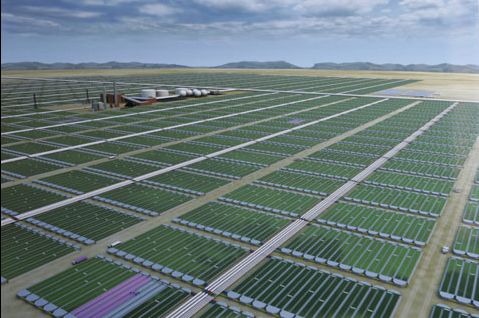
Midwest (TGW) – Green Star Products Inc. (GSPI) announced this week that it has signed a contract to build a 100-acre algae to biodiesel facility.

The plant will use the CO2 emitted from the plant to feed the algae, which reduces the overall emissions of the facility.

Algae oil will be produced at the plant, and other existing facilities will convert that algae oil to biodiesel.

Biotech Research, Inc. (BTR) has signed the contract with GSPI, and preparation for construction will begin in March 2008. BTR is planning to build several 1000-acre algae facilities.

Algae is much more efficient of a biofuel than what is used currently (corn and sugarcane). Algae absorbs CO2, and produces 100 times more oil per acre than other biodiesel sources such as soy.

Via :: Green Progress :: GSPI Press Release

Thursday, November 22, 2007

New Jersey May Ban Plastic Bags

New Jersey (TGW) – New Jersey could become the first state to ban plastics bags, under a measure introduced into the New Jersey state Assembly.

The bill would force supermarkets and other stores with more than 10,000 square feet of space to ban plastic bags.

"Plastic bags may be cheap and convenient, but they have costly long-term environmental consequences that just can't be ignored," Assemblyman Herb Conaway, a sponsor of the measure. "We need to get these bags out of the waste stream because they are polluting our soil and our water."

San Francisco became the first city last year to ban plastic bags, and New York is considering similar measures. Many countries have also banned plastic bags, because of environmental concerns.

Via :: Boston Globe

Wednesday, November 21, 2007

Largest Biomass Plant in the World to be Built in England

UK (TGW) – The UK has approved plans to build the world’s biggest biomass plant.

The $824 million, 350 megawatt plant will be built by Prenergy for Port Talbot, and will burn mostly woodchips.

"This will be the biggest biomass plant in the world, generating enough clean electricity to power half of the homes in Wales. It joins eight major renewable projects already given the green light in the past 12 months alone and is another important step towards the low-carbon economy envisaged by the prime minister."

Via :: Reuters

Tuesday, November 20, 2007

Dr. Anne-Marie Warris Discusses the Voluntary Carbon Standard

Yesterday we reported the launch of the Voluntary Carbon Standard (VCS), a brand new carbon standard that seeks to certify carbon offsets.

Yesterday, LRQA’s Dr. Anne-Marie Warris gave an interview to BusinessAssurance.com. She discusses the impact VCS will have on the market, the obstacles it will face, and outlines the next 18 months of growth. You can listen to or read the transcript of the podcast here: http://businessassurance.com/anne-marie-warris-introduces-vcs-2007/

New Indiana Clean Coal Plant Will Replace 1940s Coal Plant

Indiana (TGW) – Indiana regulators have approved a new 630 megawatt clean coal plant.

The plant will replace an existing plant built in the 1940s. It will sequester harmful carbon dioxide underground.

Via :: Reuters

Monday, November 19, 2007

Hydrogen Powered Boat!


A hydrogen powered boat designed by Kenneth Venenenbos will debut next year in Amsterdam. The boat can hold 100 people and is transparent.

British Artists Buys Solar Panels with Capacity of Generating 2% of Britain's Total

England (TGW) – Damien Hirst, the British artist, is spending $3 million on a 310kw solar power system for his home in Gloucestershire.

The panels will generate enough electricity to power 150 homes, and will cover 1800 square kilometers. The power generated by his home will account for approximately 2% of all solar energy generated in the U.K.


Only the Cooperative Insurance Society Tower has a larger solar power system.

Dave Timms, economics campaigner at Friends of the Earth, said: "This is great news. Good on Damien Hirst. He'll probably do more to boost confidence in the UK solar industry than the government has over the past few years.

"However, we can't rely on the environmentally aware wealthy to nurture the low carbon industries. We need a feed-in tariff scheme which would reward all businesses and individuals who invest in small-scale renewable technologies with a guaranteed premium price for the clean electricity they generate."

Germany already uses the specified type of system.

Via :: The Guardian

Both the UAE and Qatar Pledge $300 Million for the Environment

Saudi Arabia (TGW) – Both the United Arab Emirates and Qatar have pledged to spend $150 million on environmental research, Saudi Arabia said this week.

The vow came days after we reported Saudi Arabia promised $300 million for the environment.

Via :: Reuters

New Carbon Offsets Standard Launched

London (TGW) – The Voluntary Carbon Standard (VCS) was launched today, and aims for transparency of the unregulated carbon offsets market.

The standard has been endorsed by the International Organization for Standardization.

“Our research indicates that the VCS will become the leading standard against which all voluntary offset projects are judged,” said Richard Bayon, the director of Ecosystem Marketplace.

Andrei Marcu, President of The International Emissions Trading Association (IETA) and co-chair of the VCS Steering Committee, said: "While the main action must be in regulatory approaches, voluntary actions and offsets have an important role to play, and the VCS will provide them with necessary credibility."

Mark Kenber, Policy Director of The Climate Group and co-chair of the VCS Steering Committee, said: "The Voluntary Carbon Standard means business and consumer buyers can now trust the offsets they buy. Its robust quality assurance will trigger a new global confidence in the voluntary market from corporate buyers, consumers, and policy-makers. The VCS is vital for the environment and for growth of an important global market."

Via :: VCS Press Release